light-header


Videos made available here are from two vital resources:
The Transferware Worldwide Lecture Series - free quarterly Zoom lectures open to all. These lectures are recorded and made available to current TCC members after the Zoom session. Member login required.
Recorded presentations during TCC Annual Meetings and Conferences, including lectures presented during the 2025 TCC Hartford, Ct. Conference, which celebrated the many "Landscapes, Real and Imagined, on British Transferware!”. The meetings have been videotaped and added to the TCC website for members to view with login.
Other Films and Videos, featuring a variety of lectures, presentations, and videos, available to TCC members and site visitors. Thanks to Phil Rowley of the Facebook site Potteries of Stoke on Trent for identifying many of the presentations, available on YouTube and initially presented at the Gladstone Museum. These presentations are supplemented by suggestions from other individuals. If you have a recommendation, contact the TCC Web Administrator.
Transferware Worldwide Lecture Series ANNUAL MEETING & CONFERENCE LECTURES Other Films and Videos
Login or Become a Member
to view this video.
Lecturer: Dolores Elkin. Dr. Elkin is an archaeologist with Argentina´s National Council for Scientific and Technical Research (CONICET) based at the National Institute of Anthropology.
Description: Between 2016 and 2017 an archaeological rescue project was implemented after the accidental discovery on the coast of Tierra del Fuego, Argentina of what looked like a historic ship´s cargo. The assemblage was formed by a group of crates mainly containing 19th century English ceramics. Among the crates were transfer decorated pieces which allowed the first chronological and cultural assessment of the site. This lecture will provide a detailed illustration of the transferware items found and reveal various research strands related to the commercial exportation of British goods along the Cape Horn route.
Speaker Bio: Dolores Elkin graduated with a Doctoral degree from the University of Buenos Aires in 1996. That same year, she created the first Underwater Archaeology Program in Argentina. The goal was to initiate research of underwater archaeological sites as well as to create public awareness of their significant cultural heritage.
A professor at both the University of Buenos Aires and the National University of the Central Province of Buenos Aires, Dr. Elkin has lectured on both the undergraduate and postgraduate levels. As an experienced diver, she engages with the sport and professional diving community and fosters joint efforts to preserve Argentina’s submerged cultural heritage.
Dr. Elkin has led several nationally and internationally funded projects involving shipwrecks from the 18th, 19th and 20th centuries located in Patagonia and Tierra del Fuego. Her work has resulted in an extensive publication record intended for both the academic community and the public at large. As an elected member and former president of the Scientific and Technical Advisory Body to the UNESCO Convention for the Protection of the Underwater Cultural Heritage, she has also organized and participated in numerous national and international scientific events.
Login or Become a Member
to view this video.
Lecturer: Pat Halfpenny, Curator Emerita, Ceramics & Glass, Winterthur Museum
This lecture is co-sponsored by the Northern Ceramic Society
Description: After a brief glimpse of underglaze blue printing at the opening of this presentation, Pat goes on to introduce other late 18th century underglaze colour printing options including bi-colour printing which was undertaken on a small scale in the 1790s. The major focus of the talk is on the new colours and processes introduced from the 1820s, and which became a standard part of production by the 1830s. The story concludes with the introduction of multi-colour printing from 1835 and its widespread use after the Great Exhibition of 1851.
Speaker Bio: Pat Halfpenny specializes in the study of 18th & 19th century Staffordshire earthenwares. She began her career in 1967 at the City Museum & Art Gallery, Stoke-on-Trent, England, where she was Keeper of Ceramics from 1980-1995. From 1995-2009 she served as Curator of Ceramics & Glass, then Director of Museum Collections Winterthur Museum, Delaware, USA. In 2013 she was made Curator Emerita, Ceramics & Glass, for Winterthur Museum in recognition of her contributions.
Pat is currently on the Board of The Friends of Blue and is Chair of the Northern Ceramic Society. As an independent ceramic researcher, she continues to curate, write, lecture, and contribute to websites about ceramics.
Login or Become a Member
to view this video.
Lecturer: Corey Heyward Sattes, Wexler Curatorial Fellow, Archaeology, Drayton Hall Preservation Trust
Description: The South Flanker well site at Drayton Hall, an 18th-century plantation estate north of Charleston, South Carolina, provides a unique opportunity to examine the intentional refuse of those living on the property. Additionally, the contained nature of this context allows for us to observe relatively clear phases of trash deposits, each associated with different generations owning the house. The recovered transferware from this assemblage, and the research acquired in the Transferware Collectors Club database, has been invaluable for dating these contexts. This talk will examine the range of the recovered transferware ceramics, methods of analysis, and interpretations of their role in market accessibility and household use.
Speaker bio: Corey A. H. Sattes received her B.A. in both Archaeology and Art History from the College of Charleston, and her M.A. in Anthropology from George Washington University. Sattes currently works as an archaeologist and the Wexler Curatorial Fellow at Drayton Hall Preservation Trust, where she curates and catalogs the legacy archaeological collection at Drayton Hall using the Digital Archaeological Archive of Comparative Slavery (DAACS). She researches the material culture of Native Americans, enslaved Africans, and African Americans in the southeastern United States during and following the colonial period. She focuses primarily on ceramics manufactured and used by Native Americans and African descendants, namely colonoware. Sattes also specializes in artifact photography and digitization.
Login or Become a Member
to view this video.
Lecturer: Daniel Sousa, Assistant Curator at Historic Deerfield
Description: In the early decades of the 19th century, Connecticut River Valley merchants and store owners acquired numerous amounts of English transferware to sell to local consumers. What transferware patterns were available in the Connecticut River Valley, and how did they get there? To answer these questions, this presentation will examine the life and career of Hartford, Connecticut ceramic importer Peter Morton (1800-1846), and extant examples of his wares, along with pieces of transferware found archaeologically throughout the Connecticut River Valley.
Speaker Bio: Daniel Sousa became the Assistant Curator at Historic Deerfield in 2019. Prior to joining the museum staff in 2017 as the Decorative Arts Trust Curatorial Intern, he worked at the New England Historic Genealogical Society, and at Skinner Auctioneers. He has also served as an intern with the Boston Furniture Archive, a project of the Winterthur Museum, and has participated in the 2019 Winterthur Institute program. He holds a B.A. in history from Providence College, an M.A. in history from the University of Massachusetts, Boston, and a Certificate in Genealogical Research from Boston University.
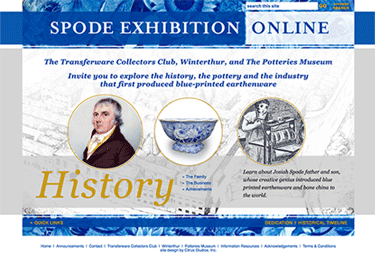
Rich with content for ceramic collectors, researchers, authors, curators, and historic archaeologists, the sites are sure to deliver value for their visitors. The exhibition’s curators continue to enhance them and, now, with site application upgrades, including a new magnification feature and upgraded content management capabilities, the TCC and its collaborators are pleased to relaunch these exhibits, all free to a worldwide audience.
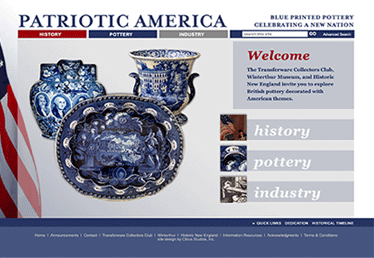
Branded Patriotic America, debuted in 2014 in collaboration with Historic New England, and the Winterthur Museum
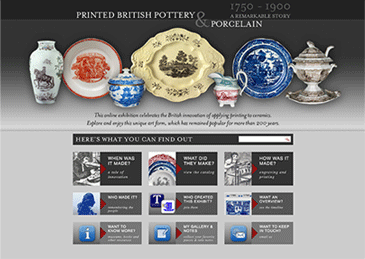
Launched in 2015 in partnership with the Northern Ceramic Society.
 Not a member but want to receive email updates?