light-header


Videos made available here are from two vital resources:
The Transferware Worldwide Lecture Series - free quarterly Zoom lectures open to all. These lectures are recorded and made available to current TCC members after the Zoom session. Member login required.
Recorded presentations during TCC Annual Meetings and Conferences, including lectures presented during the 2025 TCC Hartford, Ct. Conference, which celebrated the many "Landscapes, Real and Imagined, on British Transferware!”. The meetings have been videotaped and added to the TCC website for members to view with login.
Other Films and Videos, featuring a variety of lectures, presentations, and videos, available to TCC members and site visitors. Thanks to Phil Rowley of the Facebook site Potteries of Stoke on Trent for identifying many of the presentations, available on YouTube and initially presented at the Gladstone Museum. These presentations are supplemented by suggestions from other individuals. If you have a recommendation, contact the TCC Web Administrator.
Transferware Worldwide Lecture Series ANNUAL MEETING & CONFERENCE LECTURES Other Films and Videos
Login or Become a Member
to view this video.
Lecturer: Jonathan Gray, Honorary Research Fellow at the Amgueddfa Cymru - National Museum Wales
Description: Jonathan’s lecture considers the range of ship prints used at the Swansea Pottery and provide a revised timescale for their introduction and development. Related prints - some found together with the ship prints - will also be discussed.
Our Speaker: Jonathan is an Honorary Research Fellow at the Amgueddfa Cymru - National Museum Wales, focusing on the ceramic output from South Wales 1764-1934. He is also the meetings secretary for the English Ceramic Circle. Jonathan has written extensively on Welsh Ceramics, and published The Cambrian Company, Swansea Pottery in London 1806-1808 in 2012. He is currently finalising a book on the Art Potter Horace Elliott who was active 1880-1934 and had wares made at Ewenny near Bridgend in South Wales. Jonathan is an active member of the TCC - he presented to the group at the 2011 Baltimore meeting on Swansea's Printed Wares - A Re-assessment. His lecture is available in article form on the TCC website, read the paper.
Login or Become a Member
to view this video.
Lecturer: Robin Emmerson, Freelance Decorative Arts Curator, Shrewsbury, England
Description: The first printing on pottery was overglaze, and it was another three decades before pottery was printed underglaze. The study of overglaze printing presents a special intellectual challenge because an already glazed pot could have been printed hundreds of miles from where it was made, or in the same factory. The copper plate from which it was printed could also have been engraved somewhere else. Most printed pots do not have the signature of the engraver or printer in the print, but fortunately a few do, and these, together with documentary and archaeological evidence, enable us to trace the spread of the pottery printer’s skill from John Brooks and Henry Delamain at Battersea to Liverpool, Derby, Staffordshire and Newcastle-on-Tyne.
Our speaker: Robin Emmerson was Curator of the Decorative Art Department at National Museums Liverpool. Since retirement he was for six years Chair of the Northern Ceramics Society. He was one of the contributors to the TCC and NCS joint online exhibition on British Printed Pottery and Porcelain and wrote the essay on ‘Pottery and the Liverpool Trade’ in S. Robert Teitelman et al., Success to America: Creamware for the American Market (Antique Collectors’ Club, 2010).
Login or Become a Member
to view this video.
Title: Supplying the Present Wants of Our Yankee Cousins
Lecturer: Dr. Neil Ewins, Senior Lecturer in Design History, University of Sunderland, Sunderland, England.
Description: In 1997, the Potteries Museum and Art Gallery of Hanley published my Supplying the Present Wants of Our Yankee Cousins: Staffordshire Ceramics and the American market 1775-1880. This lecture focuses on some of the themes covered by this publication which, it is hoped, will be of interest to British ceramic enthusiasts. My fascination with this subject has never diminished and my talk will also include more recent work on this theme. The process of learning continues, as does the research.
Our Speaker: Dr. Neil Ewins is a Senior Lecturer at the University of Sunderland teaching Design History and Theory courses for BA and MA students studying design, ceramics and glass. He has worked at Sunderland for almost 20 years and is a Senior Fellow of The Higher Education Academy. He also acts as a PhD supervisor. Neil is a Fellow of the Society of Antiquaries of Scotland and sits on Editorial Board of the Journal of Business and Economic Development. His most recent book, Ceramics and Globalization: Staffordshire Ceramics, Made in China, was published by Bloomsbury Academic in 2017. He is currently working on a chapter concerning 19th century ceramics and glass for a six-volume publication entitled A Cultural History of Craft, also to be published by Bloomsbury. Neil is a proud member of the Transferware Collectors Club, and the American Ceramic Circle.
Login or Become a Member
to view this video.
Title: From Rehe, China to Staffordshire, England; The Voyage of a Chinese Image
Lecturer: Ron Fuchs, Senior Curator, Reeves Museum of Ceramics, Washington and Lee University, Lexington, VA
Description: The “India Temple” pattern made by John and William Ridgway of Staffordshire depicts a temple at the Chinese imperial summer palace, Bishu Shanzhuang, or the Mountain Estate for Escaping the Heat. Reflecting the globalized world of the eighteenth century, the design is based on an illustration in The Emperor of China’s Palace at Pekin, published in London in 1753. It copied an engraving done in 1714 by the Italian Jesuit Matteo Ripa, who introduced Western-style copper-plate printing to China. It was based on a woodblock print by the Chinese engravers Zhu Gui and Mei Yufeng, who copied a preparatory drawing or painting done by the court painter Shen Yu around 1712.
Speaker bio: Ron Fuchs is the Senior Curator of the Reeves Museum of Ceramics at Washington and Lee University, where he has worked for the last 13 years.He is a graduate of the College of William and Mary and the Winterthur Program in Early American Material Culture at the University of Delaware. He worked at Winterthur for ten years prior to moving to the Reeves. He is past president and chair of the American Ceramic Circle, and a member of the TCC.
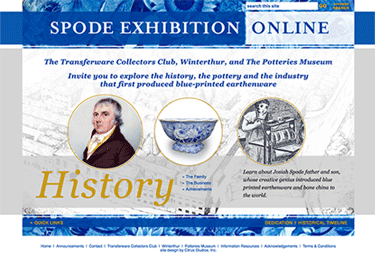
Rich with content for ceramic collectors, researchers, authors, curators, and historic archaeologists, the sites are sure to deliver value for their visitors. The exhibition’s curators continue to enhance them and, now, with site application upgrades, including a new magnification feature and upgraded content management capabilities, the TCC and its collaborators are pleased to relaunch these exhibits, all free to a worldwide audience.
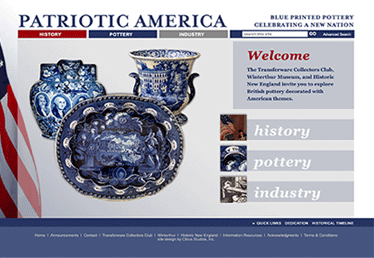
Branded Patriotic America, debuted in 2014 in collaboration with Historic New England, and the Winterthur Museum
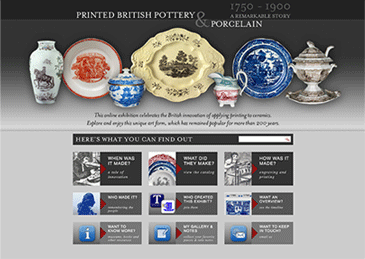
Launched in 2015 in partnership with the Northern Ceramic Society.
 Not a member but want to receive email updates?