light-header


Videos made available here are from two vital resources:
The Transferware Worldwide Lecture Series - free quarterly Zoom lectures open to all. These lectures are recorded and made available to current TCC members after the Zoom session. Member login required.
Recorded presentations during TCC Annual Meetings and Conferences, including lectures presented during the 2025 TCC Hartford, Ct. Conference, which celebrated the many "Landscapes, Real and Imagined, on British Transferware!”. The meetings have been videotaped and added to the TCC website for members to view with login.
Other Films and Videos, featuring a variety of lectures, presentations, and videos, available to TCC members and site visitors. Thanks to Phil Rowley of the Facebook site Potteries of Stoke on Trent for identifying many of the presentations, available on YouTube and initially presented at the Gladstone Museum. These presentations are supplemented by suggestions from other individuals. If you have a recommendation, contact the TCC Web Administrator.
Transferware Worldwide Lecture Series ANNUAL MEETING & CONFERENCE LECTURES Other Films and Videos
Login or Become a Member
to view this video.
Title: Two Worlds in One Shipwreck
Lecturer: Wytze Stellingwerf, Archaeologist and Specialist of Late and Post-Medieval Material Culture, Archeologie West-Friesland.
Description: This lecture discusses the extensive archival research undertaken of the shipwreck of the Pieter Anthony in Dutch Wadden Sea, loaded with early 19th-century luxury items and tools related to slavery. The Pieter Anthony, which departed from Amsterdam in November 1822, sunk only a month later during a storm in the Wadden Sea near the isle of Texel. In his lecture, Wytze shall focus on the spectacular amount of transferware that was retrieved from the wreck.
Our speaker: Wytze Stellingwerf (1992, MA) graduated at Leiden University in 2017 for the Masters in Historical Archaeology and currently works as an archaeologist and ceramics specialist of the late- and post-Medieval period in the town of Hoorn in the northern part of the Netherlands.
Login or Become a Member
to view this video.
Title: A Trip to Edinburgh: Transfer-Printed Ceramics in the Collection of National Museums Scotland
Lecturer: Claire Blakey, Curator of Modern Decorative Arts, National Museums Scotland
Description: This lecture explores the collections of British transfer-printed ceramics in the collection of National Museums Scotland which include wares made for export across the globe, as well as pieces which can be used to illustrate the technical processes of transfer printing on pottery.
Our speaker: Claire Blakey is Curator of Modern Decorative Arts at National Museums Scotland in Edinburgh. She has worked in museums across the UK, curating numerous exhibitions and publishing on topics including majolica, maiolica, the trade in Staffordshire pottery and East Asian ceramics.
Login or Become a Member
to view this video.
Title: British transferware for the Dutch Market, c. 1775-1850
Lecturer: Wytze Stellingwerf, Archaeologist and Specialist of Late and Post-Medieval Material Culture, Archeologie West-Friesland.
Description: Wytze’s lecture explored British ceramics for the Dutch market. As part of this, he also discussed the wreck of the Pieter Anthony which perished in 1822 on the way to Surinam.
Our speaker: In 2017 Wytze Stellingwerf (1992, MA) graduated at the faculty of Archaeology at Leiden University with a study of late 18th-century politically charged ceramics and glassware in the Netherlands. This resulted in the publication of a book, called “The Patriot Behind the Pot: A Historical and Archaeological Study of Ceramics, Glassware and Politics in the Dutch Household of the Revolutionary Era.” He currently works as an archaeologist and ceramics specialist of the late- and post-Medieval period in the town of Hoorn in the northern part of the Netherlands. In addition, he regularly works at Museum Kaap Skil on the Dutch isle of Texel, where he documents finds from shipwrecks done by sport divers in the Wadden Sea and North Sea. Wytze has a great interest in the rise of the Industrial Revolution and its material and sociocultural impact in Western Europe and America, especially in the 18th and 19th centuries. Furthermore, the maritime and colonial past of the Netherlands are among his greatest interests. During his internship at the depot of the Dutch National Institute of Shipwreck Archaeology in Lelystad in 2013, Wytze came into contact with 18th- and 19th-century British transferware retrieved from various shipwrecks. This led to a never-ending fascination for the beauty and fine quality of 18th- and 19th-century British earthenware which is still abundantly available at flea markets, thrift stores and auction houses in the Netherlands. He has been collecting British pottery ever since.
Login or Become a Member
to view this video.
Title: Staffordshire Hospitality: An Exploration of Staffordshire Transferware Made for and Used by the Hospitality Trade
Lecturer: Ben Miller, Assistant Curator of Ceramics, The Potteries Museum & Art Gallery, Stoke-on-Trent, England
Description: Ben’s lecture explored the 300-year history of North Staffordshire ceramics created for the hospitality industry: Ceramics that have helped to quench the thirst and fill the bellies of inn and tavern patrons, cleanse hotel guests, supply banqueting halls, and cater for travellers on land, sea, and in the air.
Our Speaker: Ben Miller has worked with ceramics collections since 2012 starting his career at The Wedgwood Museum before moving on to The Potteries Museum & Art Gallery. He completed his BA at Keele University between 2006 and 2009 and his MA at Birmingham University’s Ironbridge Institute in 2010. From 2012 to 2015 he worked as a Museum Assistant at The Wedgwood Museum during which time was able to research a wide variety of topics across the Wedgwood collection and archive. In 2015 he joined the Potteries Museum & Art Gallery as Assistant Curator of Ceramics and has since worked on several exhibitions and given talks to a number of collectors’ groups. His passion lies in Staffordshire ceramics from the 18th century to the present with a particular interest in 19th and 20th century factory production, overseas trade, and design.
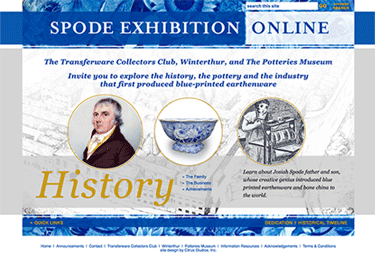
Rich with content for ceramic collectors, researchers, authors, curators, and historic archaeologists, the sites are sure to deliver value for their visitors. The exhibition’s curators continue to enhance them and, now, with site application upgrades, including a new magnification feature and upgraded content management capabilities, the TCC and its collaborators are pleased to relaunch these exhibits, all free to a worldwide audience.
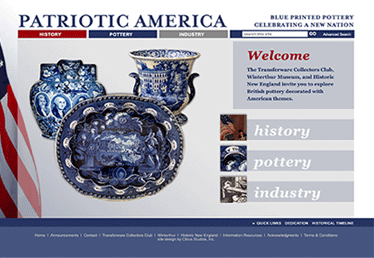
Branded Patriotic America, debuted in 2014 in collaboration with Historic New England, and the Winterthur Museum
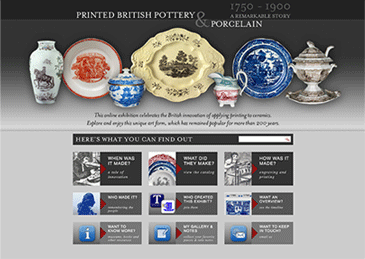
Launched in 2015 in partnership with the Northern Ceramic Society.
 Not a member but want to receive email updates?