

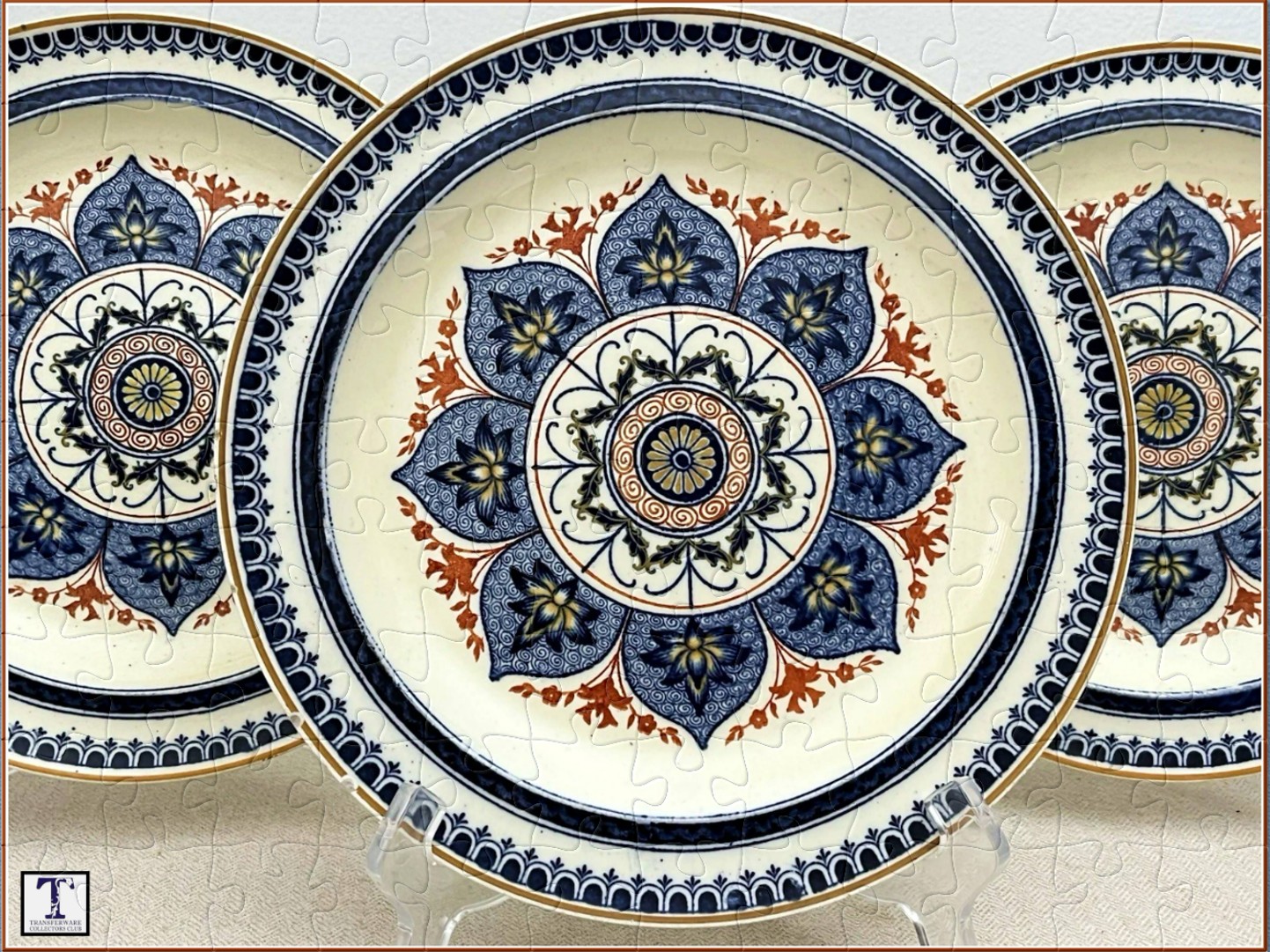
 The Josiah Wedgwood pottery was in business from 1759 to 2005. Initially located in Burslem, the firm later moved to Etruria and Barlaston, all in Staffordshire, England. The longevity of the company helps explain why it is one of the best known British potteries today. One contributing factor in that longevity was the company’s ability to lead, or at least keep up, with new patterns as the public’s taste changed.
“Chesnut” was registered in 1878 and reflects the newly popular Aesthetic Movement in its design. Patterns featuring floral centers with geometric borders had long been produced by Wedgwood. “Waterlily,” introduced in 1808, is one example. Seventy years later, the Aesthetic Movement was looking toward Japanese design influences which are reflected in the large eight petaled stylized floral medallion. Each petal has a flower-like image arranged around a circular center which holds eight smaller petals. It has a simple geometric double-banded border.
It is pattern #4130 in the TCC Database, where a brown printed example is shown. Comparison between the Database example and these plates shows that the red elements are hand painted around and in the blue printed pattern, with the umber color added to the printed elements and used for a painted line at the rim. With the unusual added design elements in red, this should perhaps be considered a variation of the pattern, not just another printed color.
From the Jameson Family Collection, Pittsford, NY. Photo courtesy of eBay seller Thomas Jameson.
 Not a member but want to receive email updates?